PFI 2026
Guide to Estimating Periodic Facade Repair Services
Facade Repair Cost Calculator
The Challenge of Facade Repair Services Budgeting Requirement
Receiving a BCA periodic facade inspection PFI Notice in Year 2026 is only the first step. Once the Stage 1 Visual façade inspectors (FI) identifies defects, Building Management Teams (MCSTs) face the daunting task of budgeting for remedial works for a one-stop solution. Without a technical breakdown, contractors often provide “lump sum” quotes that are difficult to verify against the actual scope of work.
Master Facade Rectification Modeler
Facade Repair Cost Calculator
How to Use Building Facade Rectification Moeller Assessment
Our calculator is designed to align with the façade inspections Schedule of Rates (SOR) and Singapore Standards to provide a competent person (CP) baseline for your AGM/EGM and public safety to conduct unsafe 20 years old building facade deterioration for repair works in cityscape.

Step-by-Step Estimation Guide:
- Select your Facade System: Costs vary significantly between Masonry (SS 542) and high-end Stone Cladding (SS 509).
- Input Defect Quantities: Use the detected data from your Stage 1 facade inspector PFI Report, such as the total sqm of spalling concrete rectification or the number of hollow tiles Use the facade qualify data from your Stage 1 PFI Report, such as the total sqm of spalling concrete or the number of hollow tiles.
- Allowance for Access Methods: Whether you require Rope Access (IRATA) or a Gondola setup drastically changes the mobilization budget from starting $10K, $100K and even more, depending on building type and height.
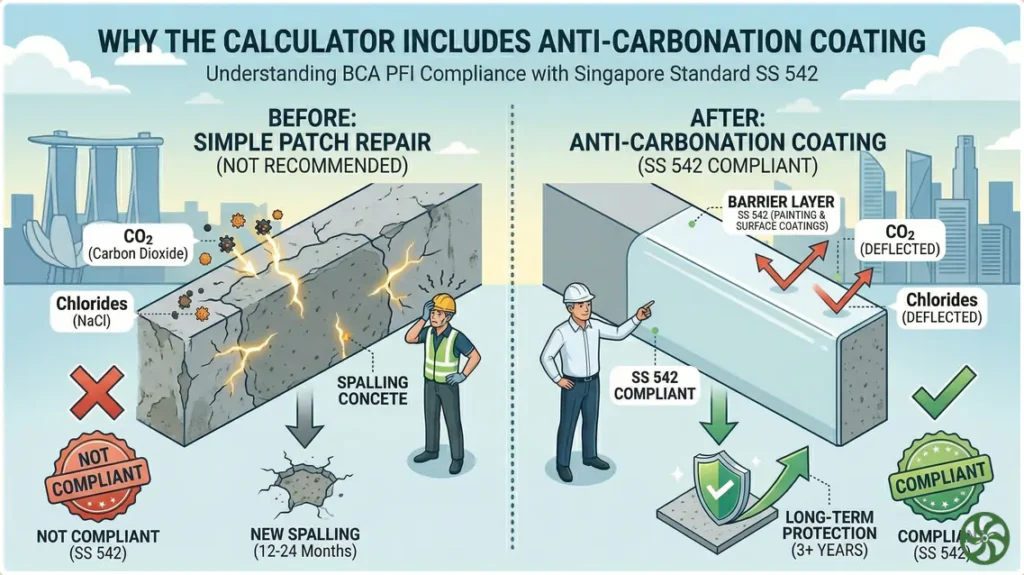
- Include Protective Coatings: We include Anti-Carbonation layers because patching without protection leads to rapid re-spalling.
Facade Repair Cost Calculator
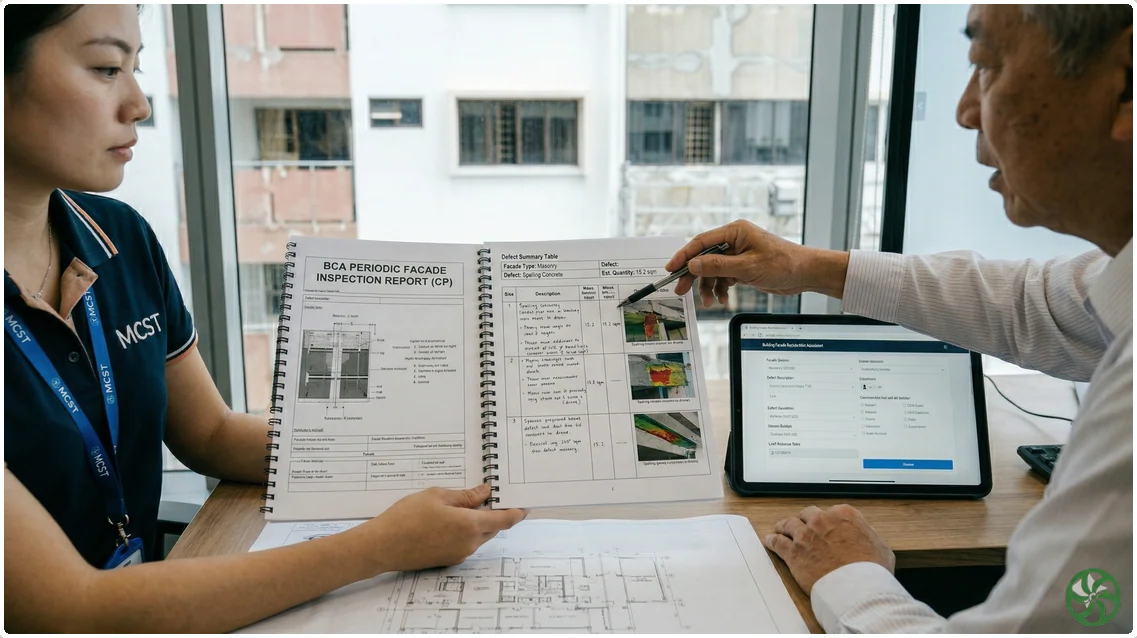
How to Estimate Quantities from a competent person (cp)’s Periodic Facade Inspection Report
A Facade Inspection Report typically provides a Defect Summary Table. Here is how to translate those technical findings into accurate calculator inputs:
1. Spalling Concrete & Anti-Carbonation (SS 542)
- The Findings: Look for “Exposed Rebar,” “Cracks with Rust Stains,” or “Delamination”.
- The Spalling Rule: For every “point” of spalling, assume 0.15 sqm of hacking to reach clean rebar.
- The Anti-Carbonation Strategy: Never just paint the patch. Measure the entire structural element (e.g., the full length of a beam) to prevent the “Halo Effect” where new spalling occurs next to a repair.
2. Mechanical Pins & Tile Replacement (SS 509)
- The Findings: Look for “Hollow Sounding” zones identified by tapping tests.
- Mechanical Pins: If a tile is hollow but stable, use 4 to 5 pins per sqm to “stitch” it back to the structure without the dust of full replacement.
- Tile Replacement: If tiles are bulging or cracked, use the exact sqm listed plus a 10% wastage factor.
3. Exterior Waterproofing & PU Injection Work (SS 637)
- PU Injection: Count the linear meters of actively leaking cracks and estimate 3 to 4 injection points per meter.
- Flood Infusion: For porous masonry seepage, calculate the total floor area (sqm) of the affected balcony.
Facade Repair
Understanding the Construction Cost Drivers: From Spalling to Compliance
Effective budgeting requires understanding the Singapore Standards that govern remedial works:
SS 542 Painting & Surface Coatings
Ensures anti-carbonation paint stops rebar from rusting again.
SS 637 Waterproofing of RC Buildings
Governs PU Grouting and membranes to stop internal leaks.
SS 509 Maintenance of Facades
Standards for repairing stone, brick, and tiled surfaces.
SS 654 Glass in Buildings
Mandatory safety protocols for replacing glass panels.
TR 78:2020 Drone Inspection Standard
The foundation for how defects were mapped in Stage 1.
Facade Repair Cost Calculator
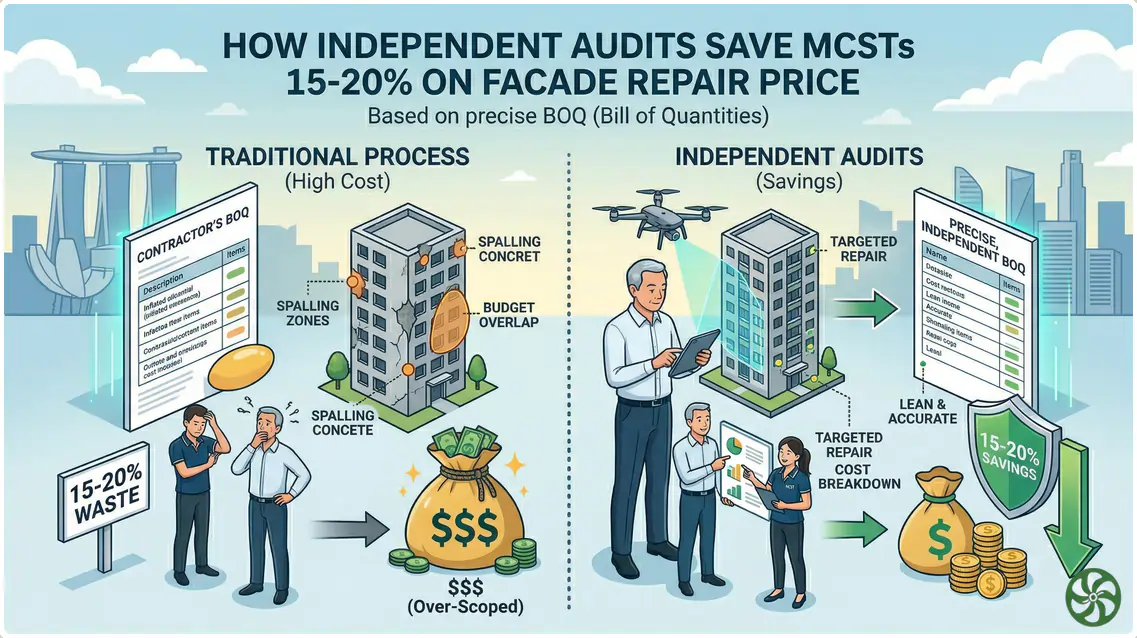
Why Independent Audits Service Save Building Management Teams (MCST) 15-30% on Facade Repair Price based on BOQ
Most contractors over-scope to “play it safe”. Our independent in-house audit methodology precisely maps defect zones, ensuring you only spend on essential repairs for the building’s exterior.
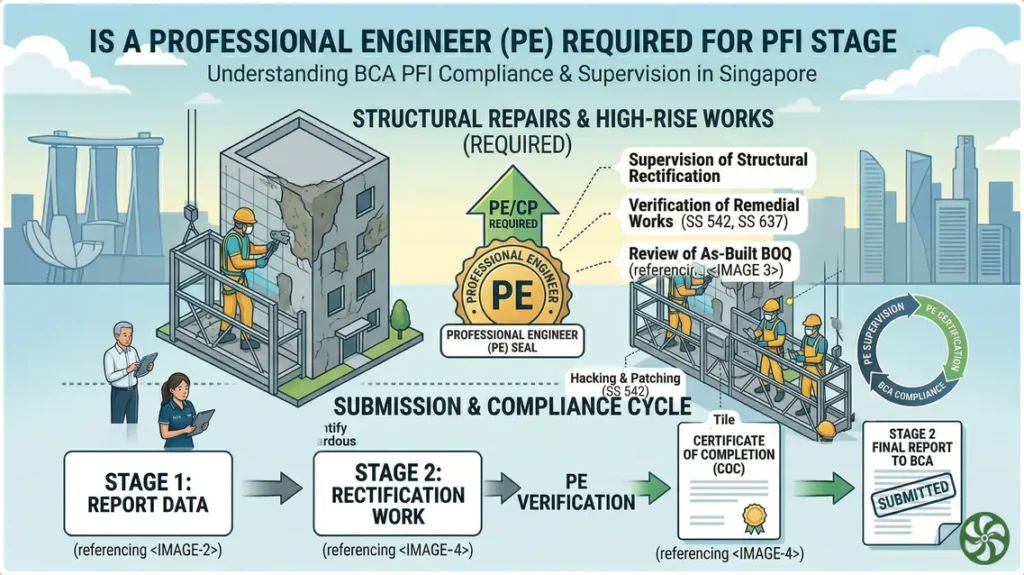
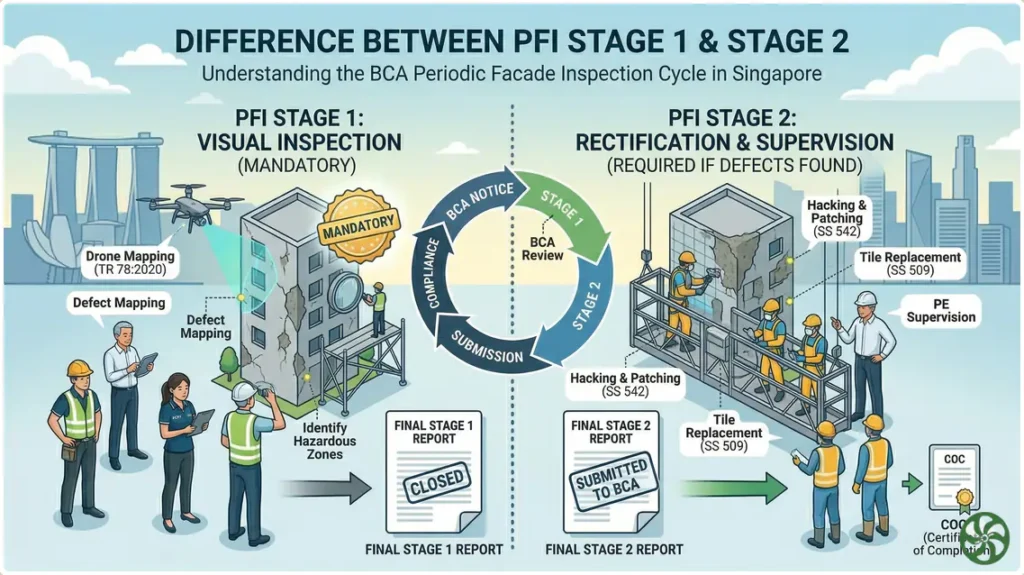
- PE Supervision: Under BCA regulations, Stage 2 works must be supervised by a Competent Person (CP) or Professional Engineer (PE) to ensure the Certificate of Completion (COC) is valid.
- Contingency: We recommend a 20% Contingency Buffer for all budget approvals to account for hidden issues like bracket corrosion behind ACP Cladding.
- Budget Validation: This estimate is a professional baseline. Would you like a Greener Air PE to review your Stage 1 Report and optimize these quantities for your Building Management Team budget?
Frequently Asked Questions
Facade Repair Works
Q: What is the difference between PFI Stage 1 and Stage 2?
A: Stage 1 is the mandatory Visual Inspection issues early; Stage 2 refers to the actual Remedial Works required by the BCA if significant defects are found. You cannot close or appeal the PFI cycle without finishing Stage 2.
Q: Why does the calculator include Anti-Carbonation coating?
A: Under SS 542, simply patching is not enough. Anti-carbonation paint creates a barrier against CO2 and chlorides that otherwise lead to new spalling within 12–24 months.
Q. Is a Professional Engineer (PE) required for Stage 2?
A: Yes. For structural repairs or high-rise works, a PE or Competent Person (CP) must supervise the rectification and submit the final report to the BCA.